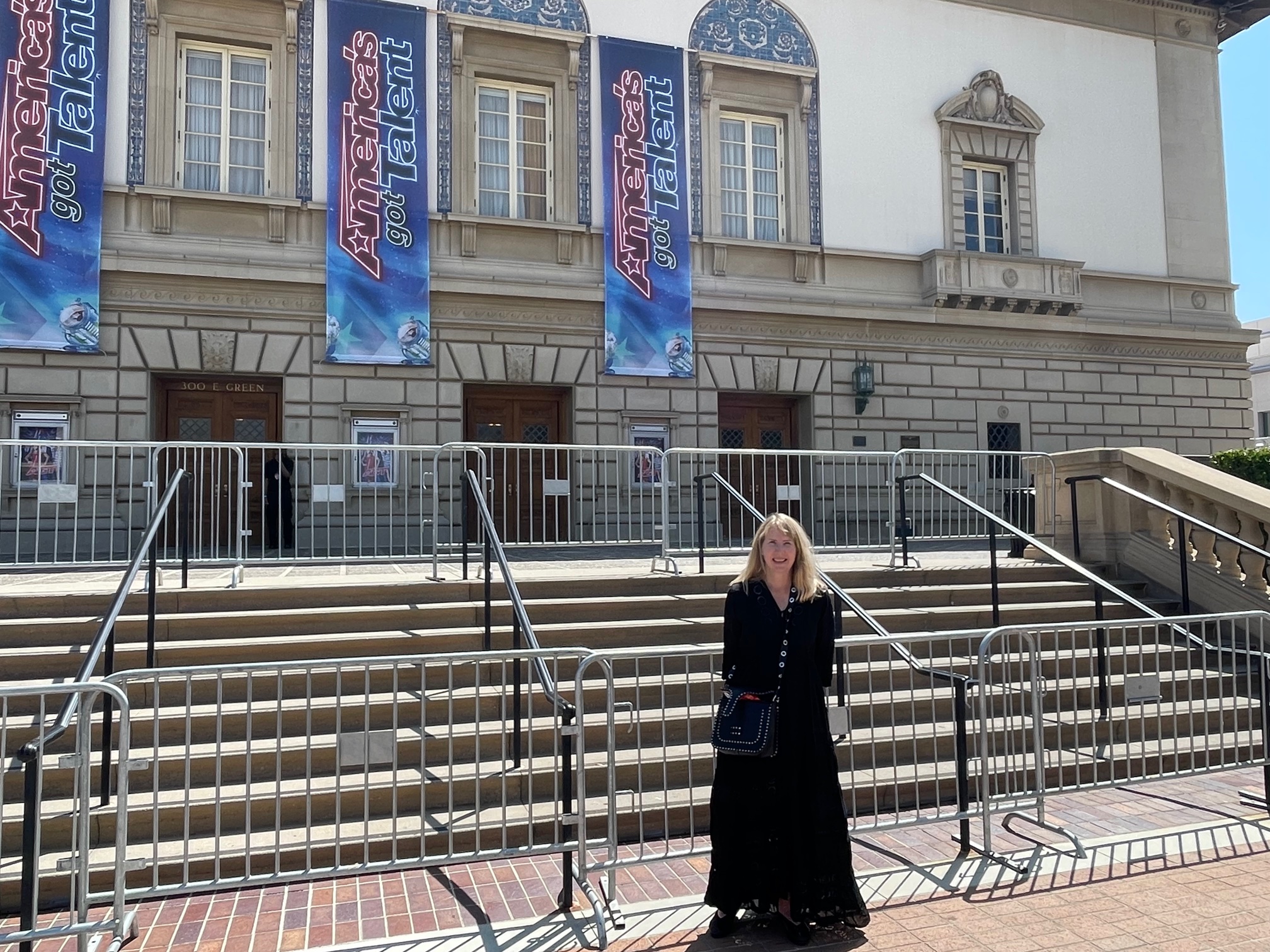

A couple of weeks ago, I went to a taping of America’s Got Talent at the Pasadena Civic Center Auditorium. I hadn’t been to television show taping before, and didn’t know what to expect. Overall, it was a really positive experience. The auditorium was gorgeous, I enjoyed watching the crew work the cameras and lights, and handle the stage sets. The warmup guy/director was energetic, the host Terri Crews kept the show moving and everyone entertained, and seeing the talented acts live gave me goosebumps. But one aspect of the experience disappointed me. The celebrity judges—Simone Cowell, Heidi Klum, Howie Mandel, and Sophia Vergara—paid no attention to the studio audience. I was told they waved when they entered, but I didn’t see this from my seat. They sat, they’re backs to us, the entire taping. Unlike, at sporting events, there was no huge screen that showed closeups of their faces and reactions.
Call me naïve, but I thought they’d at least walk on stage and thank everyone for coming—for tackling the LA traffic, for handling the ninety-five-degree heat in black clothing and closed-toed shows (the attire the studio had requested), for waiting in airport security-length lines, for agreeing to remain in their seats and not using the restroom for five hours, and for following the director’s cues. We were told when to clap, stand, and wave cell lights and lightsabers. Like I said, all of it was super fun, and I’d do it again. But as I sprang up and clapped my hands over my head for the fifteenth time, I got the sense that the show producers only cared about their television audience, not me. This got me thinking about my writing. Was I overlooking a segment of my audience? Was I truly welcoming all of my readers? Did I even know who my readers were?
If I’m being honest, I usually don’t think about my readers when I’m writing. I don’t write outlines prior to a first draft. Basically, I write stories that resonate with me. It’s only when I’m preparing to pitch my work at a conference, querying an agent, or when a fellow writing group member asks me who my target audience is, that I think about it. Always, my conclusion feels more like a guess. I find myself wishing there was a computer algorithm that could give me the answer. They’re probably is.
This is how my mind works. I’m writing about a female protagonist, so I assume my target audience is female? I write mysteries/thrillers, so I suppose my target audience is female mystery/thriller readers? And I often write about New England, so perhaps my target audience enjoys lobster rolls, sunny days at the lake, and appreciates colonials with weathered clapboard siding.
I have a friend who writes sailing adventures. He’s a big yachty. When he published his first novel and began the process of promoting it, I assumed his readers would be other boat people and I told him this. He laughed at me and said, “I thought that too. But guess what? I took my books to the local yacht clubs, and no one bought any. All my yacht buddies wanna do is drink at the bar and sail. They don’t read books.” It turns out the buyers of his sailing adventures were members of female book clubs in Orange County. Many of them were into golf. Who could have predicted this? Not me.
But back to AGT, for me, my concern of overlooking a segment of my target audience, has made me see the importance of welcoming all my readers, not just the ten million TV viewers, but the studio audience as well. And by “welcoming my readers”, I mean by making my story as enjoyable for everyone to read as possible. Doing expected things, like giving readers necessary information at the start—the main character’s name, age, sex, the genre, and story goal. Also, making reading psychically easier by considering font size when publishing, or giving readers the option to purchase an eBook so they can enlarge print.
At the AGT taping, the accompanying music overpowered the voices of the vocal performers. This made me think about how sometimes written description drowns out plot. I’ve decided that making sure my book feels balanced so my readers can appreciate it, is another way to welcome them.
At some point, as writers do we need to figure out who our target audience is? Probably. But what’s perhaps even more important is knowing who we are as writers.
My yachty friend my not have known his target audience when he was writing his novel, but he was clear about one thing. He didn’t want to dumb his book down for readers by taking out technical sailing terms. Trust me, many beta readers encouraged him to do this. They told him this would make his book more accessible to a general audience. In the end, my friend stood firm and kept in the sailing logo. His readers rose to his level and devoured his technical sailing adventure books.